I have created a separate blog for this year's visitors to The Moving Wall. On it, they can directly post observations, impressions, reflections, etc. They can also post images. This new blog has the potential to be a great journal or travelogue of The Moving Wall in 2010. Please spread the word.
Here is the blog: http://rollingwiththemovingwall2010.blogspot.com/
I am also quite honored and pleased that Sharon Denitto has requested that her excellent site, Touch The Wall, be linked here. Please visit Touch The Wall, as Sharon's hard work offers a unique perspective on The Wall, and presents information not readily found elsewhere.
http://www.touchthewall.org
Tuesday, May 18, 2010
The Things They Left Behind
 Stacked and jammed on metal racks in the shop at White Pine are taped cardboard boxes of every size. Each is identified in magic marker both by location and date: Rockford, IL 07/01-07/04 1989; Bossier City LA 10/05 - 10/11 1994; Warren RI 10/11-10/17 2004. And a thousand more. These are the things they left behind, the things visitors to The Wall deposited at its base in remembrance of somebody on the panel looming above. As part of the contract to host The Wall, site organizers collect these left behinds and send them to Vietnam Combat Veterans, LTD, the organization John Devitt begat as the legal parent of The Moving Wall.
In a way, these things they left behind are only half way home; White Pine is just a stopping point, and John is simply their custodian. He hopes to one day find a permanent home where they can be unboxed and properly displayed. For now though, they wait.

Other items are more personalized: a dog biscuit and a champagne cork in a plastic bag; funeral service cards; photocopied telegrams from the Secretary of the Army; MIA bracelets; photocopied yearbook photos; t-shirts from class reunions.

And then of course, there are the letters.
 Sometimes for all to read; sometimes sealed. Some have carefully been thought out, written slowly late at night on the kitchen table. Others scribbled in the moment, inspired by the encounter of a name. The letters tell a lot, and in a later post I will transcribe some of those public letters (ensuring the privacy of both addresser and addressee), and discuss in greater detail some of what I think the letters tell beyond what's contained in their words. But that's down the road.
 The boxes also revealed that, apart from the individual ways that people communicate with those on The Wall (as well as with others who go to The Wall) -- for, to be sure, everything left behind is a form of communication -- there are ways communities collectively symbolize paying tribute. In the Anchorage, AL, box, for instance, I found a good number of white crosses, each with a veteran's poppy stapled to the front, that some visitors had written on and others not, which presumably got staked in the ground below the panel of someone remembered.


In the Mountain View, AR, box, I found a completely different way of organizing community expression: Mountain View appeared to printout profiles of area casualties from the online site The Virtual Wall
I suspect that if I looked through other boxes, I would discover yet other unique ways that host sites established for remembering the dead.
There is much that those boxes could reveal, and much to be studied and learned. Even in the few boxes I looked through I discovered deep sockets of sadness, regret, guilt, love, loss, camaraderie, humor, appreciation, pride, and more. And that from only about 1/200 of the total collection.
Do the things they left behind deserve a permanent home and permanent display? I'd argue yes. To give you what a well-designed display might do, and to see how through the artifacts in the glass cases we are offered windows into the past as well as present, take a look at what Gail Blummer did.
Gail is General Manager of the Orland Park (IL) Civic Center and Recording Secretary of the Orland Park Veterans Commission, and long-time friend of The Wall. Convinced that the boxes contained valuable artifacts, she persuaded John to let her take some of those boxes -- I think it may have been 100 -- back to Orland Park in 2008 to create an exhibit, and to share with her community some of the things they left behind. Below are just three display cases she and her colleagues created. [Note: you can zoom in on any of the images by clicking on them twice, and then using your mouse as a magnifying glass to navigate the image.]


Everything left behind is a mystery; everything a clue. Each is part of the historical mosaic we as a nation are still trying to piece together. For those who fought in Vietnam the mosaic tries to tell the story "What we lived through." For those who weren't there the mosaic tries to tell the story "What they lived through." Same pieces; different story.
The things they left behind aren't just shrapnel stories of love and loss in Vietnam, however. They are local edits of The Moving Wall. For a quarter of a century The Wall has crisscrossed the United States providing local citizens to contribute to its telling of the Vietnam narrative. It is a single narrative repeated 58,260 times: "Here is .... who made the ultimate sacrifice in Vietnam." That's all The Wall can say. But when a thing gets left behind it says, "But wait -- there's more," and at that point one of the 58,260 becomes unique. Not better, just unique. The Wall tells the story that they all died; the things that get left behind tell the story that in life they were all unique. And when this Wall retires, at it someday will, and is put on permanent display as it surely should be, these things they left behind will need to become part of the display, too, because each is the second half of a story, of one of those 58,260 stories. And because each serves as testimony to the significance of this mobile tribute and its endless pursuit of those who needed it.


Sunday, May 9, 2010
Seamen on the Poopdeck
 In his first inaugural address, Abraham Lincoln coined the phrase "mystic chords of memory" referring to the history all Americans shared, irrespective of their significant differences. It is a lovely phrase.
 At this point in the arc of this blog, for me a less poetic but more descriptive phrase would be "mystic shards of memory" or even "distant shards of memory." Lincoln may have heard harmonious chords echoing from the past; I'm trying to pick up the pieces from a time not long ago. It's been about two months since I left White Pine and the mental images of it, and the impressions I formed there, are not quite so vibrant as they had been, and certainly not so coherent. Still, I will keep on keeping on until even the shards seem shattered.
Over the few nights that I was an adoptee of the American Legion Hall Post 462 I got to see first hand the affinity vets feel for each other, especially those of the same or similar branches. John engaged with several other combat vets to share their wartime experiences, but even more, to share the good-hearted tag-team ribbing of those non-combat vets, even those who may have served during war time though removed from the action. As far as the military pecking order goes in Post 462, Marines top the heap, followed closely by the Army, but a distant third is the Navy (I'm not sure the Air Force shows up at all). A oft-repeated laughline was "there's seamen on the poop-deck" which I also suspect got its yuks from the identical sounding "semen", and what "semen on the poopdeck" might mean. In any event, John and other land-based vets got many a good chuckle repeating that phrase.
I was, to be sure, an outsider there. Not only was I a foreigner, all the way from the east coast, but more distant still was that I had never served in the military -- not even in the Navy. However attentive I may be as a listener, no amount of listening was going to get me remotely close to actual military, and even more exclusive, combat experience. I know this and I accept it. I also understand it.
A world I could not know. It was explained to me several years ago when The Wall had traveled to my home town of Warren, RI. I had just become acquainted with John and Joy, and John was gracious enough to let me hang around while he chatted with some local vets. While it was a source of kibitzing in White Pine, I discovered there is a real, felt distinction between those vets who have seen combat and those who haven't. Not pronounced, but it exists. There is even a little bit of animosity from those who fought in Vietnam toward those who simply served during that period (stateside, in Germany, Korea, etc.), those who call themselves "Vietnam Era" vets, as though they are trying to land a place in a heroes' parade for which they haven't really paid their dues. But that is another issue.
While I eavesdropped on John's conversations with his Vietnam "brothers" I came to find out what an extraordinary thing combat is -- how on the one hand it can be the ultimate, terrifying rush, and on the other hand the greatest source of human bonding men can know. John and others made it pretty clear to me that, if they bought Washington's rationale going in, once they got to Nam the scales fell from their eyes. The war was a bungle, run by incompetent officers who, if you didn't watch out for them, would get you killed. Maybe hindsight is 20/20, but I got the sense that many a vet did not believe in the story they were told about our being there -- to stop communist aggression, etc., and came to measure victory simply in going home alive. They felt lied to by their government. But while they felt little loyalty to an untrustworthy government they felt great loyalty to each other. The G.I.'s mission in Vietnam was not to fight for "America" but rather to fight for your brother, to keep him alive. For the guys firing the guns, the war was not a series of speeches or geo-political abstractions. It was bullets and artillery, and how not to get hit by them. Survival was the name of the game, and survival was, in Nam, a team sport. Survival meant interdependence, and interdependence meant trust, valor, watching each other's back. It was just too easy to die there.
While The Wall was in Warren, I spoke with a vet who walked me over to his truck to show me something. There, on the front seat, were scattered several small clear plastic bags. Inside each was a photo of some smiling soldier in dress uniform, and an accompanying page of information. The information included the soldier's name, date of birth, hometown, etc. The information also listed the date the soldier landed in Vietnam, and the date he was killed, because all the soldiers on the front seat of that truck were killed in action. It was shocking. Most of those killed, that I saw, died within a few weeks of having arrived. Several were killed within a few days. The greatest enemy was ignorance; the greatest killer, innocence. I gleaned from those plastic bags, and from bits and pieces of conversation, that if a soldier could get through the first few weeks "in country" there was a good chance that he would outlive the war, because, after a few weeks he would have learned how not to get killed, and how to count on his brothers as he would have them count on him. Knowing this, in a way, I can understand some of the immediate furor over Maya Lin's original design of The Wall, and why the issue of amending The Wall with the sculpture of the three soldiers was so important:

The Wall can only address the failure to return home alive of those whose names it bears; the three soldiers speak to the comradeship and brotherhood that got those whose names escaped The Wall home alive. Perhaps honoring the dead wasn't enough to memorialize about the war; perhaps honoring, and in a sense reliving, the self-sacrifice and spirit of camaraderie that existed among those who dodged the bullets, or took them, and fired them, is something to be cherished and remembered, not by people like me who weren't there and couldn't know, but by those who were, and need to have something substantial to fix their pride and appreciation to.
The statue of the three soldiers may have been necessary for just that reason; to honor not only those who were lost in the war but those who survived it. The Moving Wall seems to accomplish both aims, despite the fact that there is no replica of the three soldiers (nor of the nurses statue). As it is brought to towns largely by vet's groups -- and it is for the vets more than anyone than John has been toting The Wall all these years -- it can be argued that those same vets are its primary audience, providing a place for them to come and gather, trade stories, and thank their stars, the names on The Wall, and each other they're alive. Collectively as well as individually The Wall enables them to appreciate not only the sacrifice of their fallen brothers but also the commitment of those grizzled old men who, thanks to the common yet uncommon bonds of soldier to soldier, have lived all these many years, to grow from skinny high school kids to men with paunches, jowls, bald spots, and watery tattoos, to men with wives, children, grandchildren, and maybe even great grand-children. Men with full-lives. The Wall reminds them of the time, that there was a time, when life's longevity was a crapshoot.
Lincoln spoke of the mystic chords of memory. For the vets who come to visit, The Wall plucks those strings, strums those chords. Vietnam was a horrifying yet mystical time for those who survived it. It is right and fitting that they have some common ground to celebrate their mutual survival, and the surviving memories of those less fortunate.

Saturday, April 17, 2010
Veterans' Benefits
Following a successful day of printing, and a successful evening of celebrating that successful day, we closed up shop around 9:00 or so and headed over to the American Legion Hall for pizza. As I stated in an earlier post, the American Legion is one of two public places to socialize in White Pine, the other being the bar at the Konteka. With a population of 250, that means in White Pine there is a watering hole for every 125 people. I don't know if that per capita figure is high or low by national standards, but the choice of two saloons seems rather limiting to city slicker me. On the flip side, with only two places to go, you're pretty much assured of a crowd at either one.
We rolled up to the American Legion Hall, an indistinct white one-story building whose most notable feature was the full-sized military tank parked on its front lawn. If White Pine ever went to war with Silver City or Bergland, White Pine would kick ass.
John, Joy, and myself walked into the hall and while they were greeted with "Hi"s I encountered unsaid "Who's this guy?" and accompanying stares. Not hostile or anything. Just curious in the way a town of 250 people located in the middle of nowhere who likely don't see many passers through might be. I immediately closed rank behind John and Joy to affirm that I was with them.
Joy and I plopped ourselves on barstools while John went to shake somebody's hand. The bartender -- a friendly, middle-aged woman on the short side -- swung by with a Bud Light for Joy and a JsC (Jack splash Coke) for John. When asked what I'd like to drink and seeing none of the la-di-dah microbrews that both entice and confuse me back home, I asked for an Old Style.
Not bad. Could be worse.
Joy ordered up two or three pizzas, as we were expecting Aaron and Lisa and a couple other people from the shop to be joining us. The pizzas were pretty simple affairs. Prepackaged and frozen, they were slid (after the plastic wrap had been removed) into a teeny-weeny electric pizza oven (more like a big toaster flipped on its side) to cook until done, about 15 minutes.
 I had been nibbling constantly while we were in the shop and so I wasn't as hungry as I might have been, but the sound of something more substantial than taco chips and dip did fire-up my appetite some. Now that I had some time to kill before the pies arrived, and my celebrity had kind of lost out to unfinished cigarettes, drinks, and conversation, I had a chance to snoop around a little.
For as dull and indistinct as the hall is outside, it shines with craftsmanship, creativity, and civic pride on the inside.

 I haven't been in a lot of American Legion Halls or VFW halls, but those I have been in have traded off a sense of dreariness with functionality: they were nothing to look at, but they worked. That is, they provided a welcome gathering place and served decent drinks at better than decent prices. White Pine's American Legion Hall, on the other hand, was bright, clean, and chock full of local chatchkas and memorabilia enough to fill the place with spirits even when no one was there.
How to begin? First, we have to start with Jim, the quiet, shaggy master carpenter who stopped by the shop earlier that day to have a beer and observe the printing process. Jim, as I mentioned in my last post, mills his own wood, and as it turned out all the sparkling white pine boarding that made up the walls of the hall were turned by his hand. Beautiful, angled tongue-and-groove white pine.

The bar, shaped like a shepherd's staff imaginatively blends White Pine's military past with its industrial past. The length of the bar features patches, post-cards, and period photos of local of White Pine's service men and women (playing it safe here: I don't recall having seen a picture of a servicewoman) stare up from beneath a several inches thick layer of clear laminate.


 Some were photos from World War II but most were from more recent conflicts. It surprised me that such a small town (even when it was big) had produced so many vets. Whatever its per capita rate for saloons may be, its per capita rate for townspeople who've served is surely off the charts.
Sprinkled between the photos like chocolate shavings on a cake are shining copper slivers harkening back to White Pine's mining days. Maybe the bar and the young-ish faces looking up from it have become old hat to members of the hall, but I found the history locked in that laminate fascinating, and the simple idea of it brilliant.
There are four finger bars,

constructed and decorated consistent with the main bar, what with photos and copper slivers, but each finger bar has its own theme. One is dedicated entirely to fixing in memory copper mining and the industry it brought to town. Aerial views of the mine, the refinery, etc. Another finger bar displays photos celebrating The Moving Wall's 25th year when it returned home to White Pine in July of 2009 and went on exhibition there.

(I forget what the other two finger bars concerned themselves with)
Of course, there are other ways to look than down, especially in this hall. If you look up, you will see a patchquilt of ceiling tiles,

each individually painted to honor a military unit, to bookmark one's tour of duty, or to remember a lost family member or comrade.

Much like one can spend a good bit of time moseying down the bar, poring over it like one big photo album, one can also walk around the open floor, head tilted back, reading the ceiling and learning a good bit about White Pine's military contributions, some of whom have gone heavenward.

We rolled up to the American Legion Hall, an indistinct white one-story building whose most notable feature was the full-sized military tank parked on its front lawn. If White Pine ever went to war with Silver City or Bergland, White Pine would kick ass.
John, Joy, and myself walked into the hall and while they were greeted with "Hi"s I encountered unsaid "Who's this guy?" and accompanying stares. Not hostile or anything. Just curious in the way a town of 250 people located in the middle of nowhere who likely don't see many passers through might be. I immediately closed rank behind John and Joy to affirm that I was with them.
Joy and I plopped ourselves on barstools while John went to shake somebody's hand. The bartender -- a friendly, middle-aged woman on the short side -- swung by with a Bud Light for Joy and a JsC (Jack splash Coke) for John. When asked what I'd like to drink and seeing none of the la-di-dah microbrews that both entice and confuse me back home, I asked for an Old Style.
Not bad. Could be worse.
Joy ordered up two or three pizzas, as we were expecting Aaron and Lisa and a couple other people from the shop to be joining us. The pizzas were pretty simple affairs. Prepackaged and frozen, they were slid (after the plastic wrap had been removed) into a teeny-weeny electric pizza oven (more like a big toaster flipped on its side) to cook until done, about 15 minutes.

For as dull and indistinct as the hall is outside, it shines with craftsmanship, creativity, and civic pride on the inside.


How to begin? First, we have to start with Jim, the quiet, shaggy master carpenter who stopped by the shop earlier that day to have a beer and observe the printing process. Jim, as I mentioned in my last post, mills his own wood, and as it turned out all the sparkling white pine boarding that made up the walls of the hall were turned by his hand. Beautiful, angled tongue-and-groove white pine.

The bar, shaped like a shepherd's staff imaginatively blends White Pine's military past with its industrial past. The length of the bar features patches, post-cards, and period photos of local of White Pine's service men and women (playing it safe here: I don't recall having seen a picture of a servicewoman) stare up from beneath a several inches thick layer of clear laminate.


Sprinkled between the photos like chocolate shavings on a cake are shining copper slivers harkening back to White Pine's mining days. Maybe the bar and the young-ish faces looking up from it have become old hat to members of the hall, but I found the history locked in that laminate fascinating, and the simple idea of it brilliant.
There are four finger bars,

constructed and decorated consistent with the main bar, what with photos and copper slivers, but each finger bar has its own theme. One is dedicated entirely to fixing in memory copper mining and the industry it brought to town. Aerial views of the mine, the refinery, etc. Another finger bar displays photos celebrating The Moving Wall's 25th year when it returned home to White Pine in July of 2009 and went on exhibition there.

(I forget what the other two finger bars concerned themselves with)
Of course, there are other ways to look than down, especially in this hall. If you look up, you will see a patchquilt of ceiling tiles,

each individually painted to honor a military unit, to bookmark one's tour of duty, or to remember a lost family member or comrade.

Much like one can spend a good bit of time moseying down the bar, poring over it like one big photo album, one can also walk around the open floor, head tilted back, reading the ceiling and learning a good bit about White Pine's military contributions, some of whom have gone heavenward.

***
The pizzas arrived,

and while I can't say they reminded me of pizza as I've grown up knowing pizza, they were hot, and cheesy, and generously offered by Joy. I certainly had my fill.
After this, my first full day in White Pine, I began to reflect upon what it might be like living there. To an outsider from densely populated Rhode Island, at first glance there doesn't seem to be much to do, nor many people to do it with. To an outsider, it looks, in a word, boring.
But, outsiders never really see what insiders see, or live, and so I suspect that my initial impressions probably do not faithfully represent life in White Pine. Yes, they don't have a movie theater or a mall, no nearby arena or sports teams, but maybe White Piners don't need that. Maybe they find enough entertainment in the woods. I don't know.
As for socializing, I wonder what it's like knowing that wherever you go -- of the two places to choose from (the Konteka and the American Legion Hall) -- you are going to know everybody there, and will have likely seen them the night before, and the night before that, on back to the beginning of time. On the one hand, that may produce a sense of social claustrophobia, as though you're cooped up with the same people day in and day out. And yet, I suspect there is another way to look at this rather small and tight circle: that because you do see the same people day in and day out, you form stronger bonds with them than you might among a larger pool of acquaintances, that you get to know them more intimately than you would in more transient communities. This is not to say that everyone loves everyone else in White Pine. I'm sure they don't. But I suspect that everyone knows everyone in White Pine far far better than, say, someone like me, who knows next to nothing about my townsfolk (even my neighbors), in Warren.
My point: White Pine appears very still, very quiet, not much going on or holding it together. I suspect that a number of townspeople might agree with me. But as John is attempting to show in the shop, and as Jim and Kevin and all those whose faces peer up from the hall's bar or whose panels hang down from its ceiling, little White Pine can muster up some tank-sized pride.

and while I can't say they reminded me of pizza as I've grown up knowing pizza, they were hot, and cheesy, and generously offered by Joy. I certainly had my fill.
***
After this, my first full day in White Pine, I began to reflect upon what it might be like living there. To an outsider from densely populated Rhode Island, at first glance there doesn't seem to be much to do, nor many people to do it with. To an outsider, it looks, in a word, boring.
But, outsiders never really see what insiders see, or live, and so I suspect that my initial impressions probably do not faithfully represent life in White Pine. Yes, they don't have a movie theater or a mall, no nearby arena or sports teams, but maybe White Piners don't need that. Maybe they find enough entertainment in the woods. I don't know.
As for socializing, I wonder what it's like knowing that wherever you go -- of the two places to choose from (the Konteka and the American Legion Hall) -- you are going to know everybody there, and will have likely seen them the night before, and the night before that, on back to the beginning of time. On the one hand, that may produce a sense of social claustrophobia, as though you're cooped up with the same people day in and day out. And yet, I suspect there is another way to look at this rather small and tight circle: that because you do see the same people day in and day out, you form stronger bonds with them than you might among a larger pool of acquaintances, that you get to know them more intimately than you would in more transient communities. This is not to say that everyone loves everyone else in White Pine. I'm sure they don't. But I suspect that everyone knows everyone in White Pine far far better than, say, someone like me, who knows next to nothing about my townsfolk (even my neighbors), in Warren.
My point: White Pine appears very still, very quiet, not much going on or holding it together. I suspect that a number of townspeople might agree with me. But as John is attempting to show in the shop, and as Jim and Kevin and all those whose faces peer up from the hall's bar or whose panels hang down from its ceiling, little White Pine can muster up some tank-sized pride.
Saturday, April 10, 2010
It Takes A Town to Raise This Wall; It May Take This Wall To Raise A Town
It is around one in the afternoon when I make it to the shop. John stands by the work table stirring a spatula round and round in a styrofoam cup filled with with what looks to be white frosting or glue.

“So, that's the paint,” I ask.
“No,” he says, with the slightly lost patience of one who's been asked the same dopey question a million times, “it's ink,” he corrects, still stirring, “We're printers. Not painters.”
Oops.
And so my first lesson of the day devoted to demonstrating just how The Wall gets silkscreened is to learn that silkscreening is printing of a sort. I suppose in part it's the duplicability of it which makes it printing and not painting. Andy Warhol's original Campbell's Soup Can may have been a painting,
“No,” he says, with the slightly lost patience of one who's been asked the same dopey question a million times, “it's ink,” he corrects, still stirring, “We're printers. Not painters.”
Oops.
And so my first lesson of the day devoted to demonstrating just how The Wall gets silkscreened is to learn that silkscreening is printing of a sort. I suppose in part it's the duplicability of it which makes it printing and not painting. Andy Warhol's original Campbell's Soup Can may have been a painting,

but every silkscreen after that was a print.

I get it.
As part of his invitation to the community, to share with them what he and his crew do inside the cavernous warehouse each winter to ready The Wall for yet another summer on the road, John had announced informally around town that anyone wanting to drop by today to see the silkscreening process was welcome to. John's demeanor also suggests that he neither expects anybody to show, nor will he make fanfare if anybody does.
As John mixes the ink, Aaron, Joy, and Lisa ready the panel to be printed. This means that they choose the panel to be silkscreened, freshly coated in a durable, high gloss black finish, and lay it flat on the table. Depending upon what panel they are preparing (it could be any one of 140; 70 West panels and 70 East panels), they will unroll the photographic transparency taken of the corresponding panel on the Vietnam Veterans Memorial, carefully align it for margin, edge, and header consistency with the other of The Moving Wall's panels, and then tape the transparency precisely in place onto the panel. This they do.
As part of his invitation to the community, to share with them what he and his crew do inside the cavernous warehouse each winter to ready The Wall for yet another summer on the road, John had announced informally around town that anyone wanting to drop by today to see the silkscreening process was welcome to. John's demeanor also suggests that he neither expects anybody to show, nor will he make fanfare if anybody does.
As John mixes the ink, Aaron, Joy, and Lisa ready the panel to be printed. This means that they choose the panel to be silkscreened, freshly coated in a durable, high gloss black finish, and lay it flat on the table. Depending upon what panel they are preparing (it could be any one of 140; 70 West panels and 70 East panels), they will unroll the photographic transparency taken of the corresponding panel on the Vietnam Veterans Memorial, carefully align it for margin, edge, and header consistency with the other of The Moving Wall's panels, and then tape the transparency precisely in place onto the panel. This they do.

Now that the transparency is secure, they can align the actual silkscreen – whose names will be printed on the panel, with the names on the transparency.
To make this alignment, they slip white paper beneath the transparency and the panel, so that the black names on the transparency show against the white background of the paper.
To make this alignment, they slip white paper beneath the transparency and the panel, so that the black names on the transparency show against the white background of the paper.

Then,by means of clamps and hinges, they swing over the the aluminum-framed silkscreen until it sits flat on stacks of metal spacers, an inch or two above the panel (there has to be a space between the screen and the panel; I forget the actual reason why, though I guess it's because they have to apply pressure to the silkscreen, and if it lays atop the panel the result will be more abstract art than Moving Wall). They then press down on the silkscreen in various spots and eyeball the names on the silkscreen with those of the transparency.
Using sawed off ax handles and rubber mallets, they lay the handles flat on the table and jockey the panel back and forth with a series of horizontal and vertical taps to the the panel's top, bottom, and sides, so that the names line up perfectly.
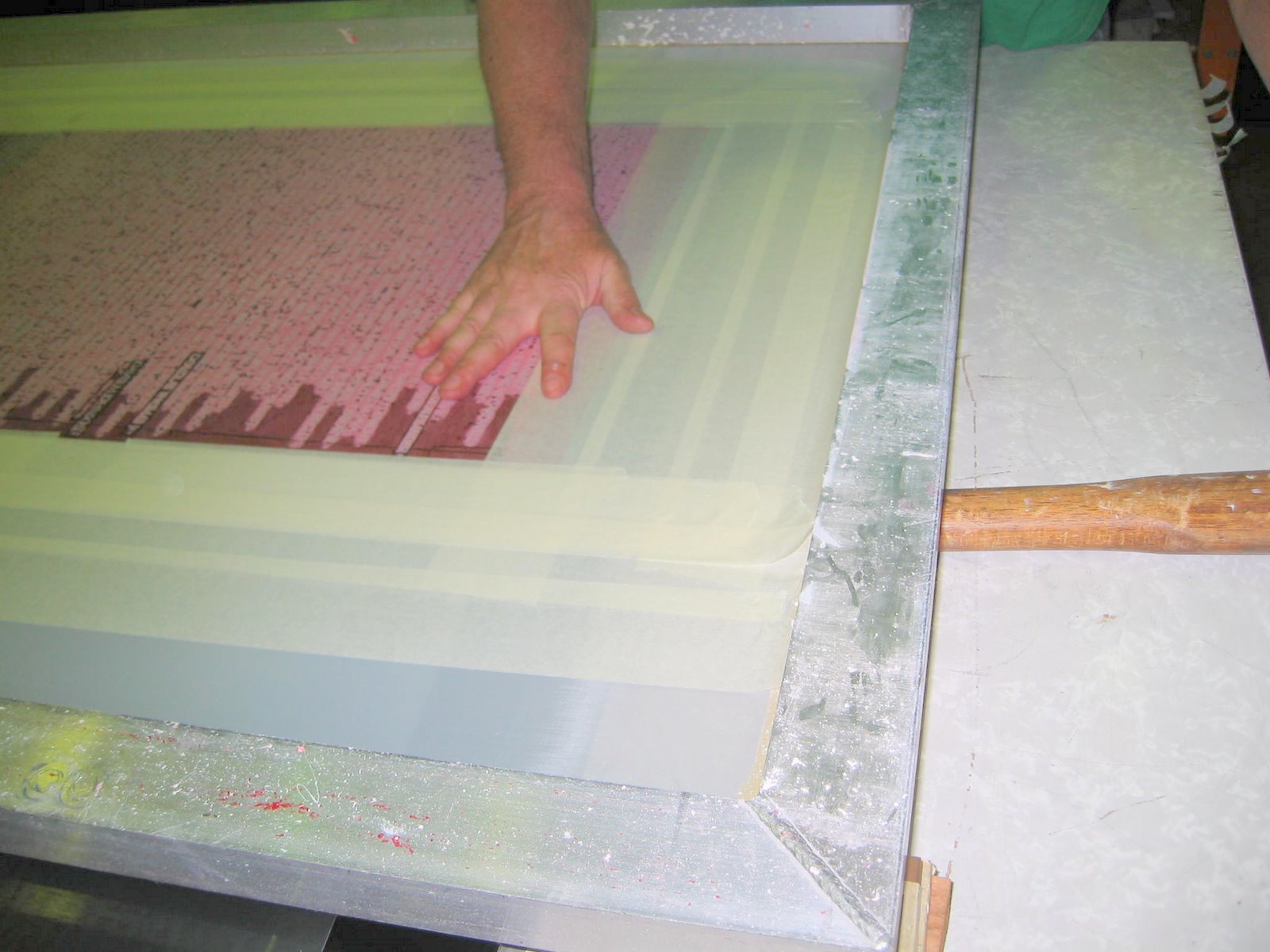
That done, the silkscreen is swung back up. They secure the panel in place on the table, and remove both transparency and paper, leaving the bare panel.
Enter John the Inkman. Ready to print, he puts the ink down for the moment and lowers the silkscreen back over the panel, checking the surface for irregularities (such as a warp) that could produce an irregularity in the print (faintness, blotchiness) if not corrected. He spots a warp, and instructs Joy to apply CPR-like pressure to the panel to get it to lay flat.
John then picks up the ink and pours a thick strip of the goopy ink across one end of the silkscreen.
Enter John the Inkman. Ready to print, he puts the ink down for the moment and lowers the silkscreen back over the panel, checking the surface for irregularities (such as a warp) that could produce an irregularity in the print (faintness, blotchiness) if not corrected. He spots a warp, and instructs Joy to apply CPR-like pressure to the panel to get it to lay flat.
John then picks up the ink and pours a thick strip of the goopy ink across one end of the silkscreen.

Again putting the inkpot aside, he picks up a two or so feet long, flat stick whose one end he offers Aaron and the other he keeps for himself. He and Aaron then lay the stick flat against the silkscreen just above the ink and, spacing their hands evenly across the stick, and with what seems like quite a bit of downward pressure, they slowly drag the stick the length of the panel, squeegee-like, in so doing forcing the ink through the free spaces of the silkscreen and onto the panel.

By the the end of the inking they are a little winded, but when the silkscreen is lifted up for a peek, voila!, a printed panel.

I don't know if the ink is expensive, if John is frugal, or if, like me, he is simply conscious of waste (maybe it's all three), but after each panel has been printed, all hands grab the frame and hold tight as he squeegees the stick back and recaptures every last bit of excess ink from the printing and returns it to the cup.

When the excess ink from this panel is back in the pail, they stand the silkscreen up on its side and lean in to inspect the panel more closely. Because the transparencies are old from which the silkscreens are made, and some damaged, whatever imperfections exist on a given transparency will appear on the printed panel. Therefore, there might always be a bit of touch up – dots that are gibbous or crescent but which should be full – which call for a fine paintbrush and a steady hand. On this day Jeff, Lisa's son, takes up this responsibility, and indeed the crew points out a number of spots for Jeff to touch-up.

As each panel bears two columns of names, a blank panel such as the one they have just printed would need to go through the whole process again to print the second column,
 but before the second column of names can be added the first column's ink has to cure and harden. Bake, actually. And so following the just completed printing and touching-up, Aaron carries the heavy, steel-framed panel over to the makeshift walk-in oven John had concocted that has been heated up to between 250 and 300 degree, in which the panel will bake until “done,” about forty-five minutes to an hour.


The last step of the process (for now) sees the framed silkscreen unclamped from the table hinge and carried over to a shower stall shrouded around with reddish shower curtains. There, donning a mask and a squirt bottle, Jeff sprays the screen thoroughly with bleach, the red from the silkscreen dissolving and washing away as he does.

Once cleaned and dried, that screen will be able to be shot with the image of another panel. Tomorrow's demonstration.
Several other panels are printed that day, probably three or four in all. Because the work is so exacting, it is also quite slow. This isn't any assembly line. It is, if not art, than at least artistic.
Several other panels are printed that day, probably three or four in all. Because the work is so exacting, it is also quite slow. This isn't any assembly line. It is, if not art, than at least artistic.
***
Throughout that process, which took much longer to complete than for you to read about, I was busy taking pictures, asking questions, generally getting in the way. And so I can't say how many White Piners actually took up John's invitation. Several people came in and out, though how many of them came to see the printing, and how many just dropped by to say hi, I could not tell. I did notice one guy – Jim – who dropped by and hung around for a while. Jim, a master carpenter (he mills his own wood), sat quietly in a chair by the table, drinking a beer and watching from afar.

That was all John wanted to hear. “That's my point. Not enough people know what we do out here. If they'd only come out and see, I think they'd get a better appreciation of The Wall, and what it takes to keep this thing going.” He took a sip of his Jack-splash-coke and then stared into the glass. “We've seen what happens when The Wall isn't kept up,” he said, leaning back, looking up. “A few years ago we retired the B wall and donated it to Pittsburgh State University, who built up this really nice memorial to house it permanently. I mean, they spent some money on the design and construction of the site, and we were kind of blown away. I mean, it's really nice. Has all these walkways and such. They must have spent a tone of money on it. But then they put up The Wall and just ignored it. Just left it to the elements. Well, it didn't take long for the Kansas weather to kick the crap out of it. Now, the panels are all kind of gray, and the names, you can barely see them let alone read them.

So now, they're trying to raise all this money to restore them, somehow. I think they're going to try to remake them in granite or something, something I guess they can make and then ignore.”

John, by nature, is slow to criticize, but his expression this moment does little to hide the dissatisfaction he feels toward the way The Wall has been treated out in Kansas. He says no more about it, but clearly he has more to say.
Jim leaves after a while, and other townsfolk come by, sometimes to stay for a beer, sometimes just to check in. Soon, George Thorogood's “Gear Jammer” (my pick) blares from Shanghai Kelly's jukebox, chips and salsa sail onto the table and fly off again almost immediately, and the workshop is on its way to becoming a playroom.
Drinking my beer, listening, watching, like a slow developing picture it's becoming clear to me what this shop means to White Pine, and what John wants it to mean to White Pine. By his design, the shop is as much social space for White Pine as it is workspace for The Moving Wall, and the relationship between the two, between social space and work space offers a kind of symbiosis: each breathes life into the other. Seats around the table are open to any who want to occupy them. The jukebox will play to any who want to push its buttons. The refrigerator opens to any who wants to pop a beer or chill a six. But so too, The Wall employs, in fact, proudly employs, about ten White Piners, making it one of the towns largest employers. And while I know that John isn't just going to hand out cash, I do get the sense that if someone is legitimately looking for work John will, if able, find a way to put them to work, even if for only a few hours a week. That someone who works on The Wall also sips beer at the table is natural; that someone who sips at the table might also work on The Wall is also natural. Chicken or egg.
Maybe I'm romanticizing, becoming melodramatic, but within just one day I got the sense that the shop was to White Pine what levies are to a slowly rising river. That throughout White Pine the tides of misfortune are mounting – lost jobs, lost property values, lost people, an overall lost sense of fortitude, of promise, of pride. Inside its door and walls, the shop holds back those tides. It doesn't erase them, but it doesn't admit them, either. Instead, the shop is kind of a refuge. In it, White Piners, gather in small numbers, and talk and laugh and play music and drink beer and dribble salsa down their sweatshirts, and for the time they spend in that warm chamber, perhaps themselves getting slightly baked, they are not cured of what ails them but their symptoms are chased away for a while.
In a sense, I suspect that what The Moving Wall is to the thousand-plus communities it's visited over the past quarter century, the shop of The Moving Wall is, or is becoming, to the community of White Pine. I will come back to this idea.
Saturday, April 3, 2010
The Shop (Part 1)

Joy answered.
“Hey Joy. I'm here.”
“Hey. Do you want to come to the shop?”
I hadn't actually anticipated going there so soon, but, why not? “Sure. I'd like that.”
“Okay. So you need directions, ā? Wait...”
I waited.
“John says he'll come and get you.”
“Great. I'll be waiting outside.”
A few minutes later I was standing in the Konteka's potholed parking lot when a cream colored Chevy pick-up, a relic, turned into the lot and gently rolled up to me. I hopped in the cab and John and I exchanged great-to-see-yous! He looked the same as when I saw him outside Boston this past summer, perhaps a dash more salt to his beard, perhaps another inch or so to his braided ponytail. But still the easy manner, the quick smile and laugh, even after a UP winter.
Between how ya doins I scanned the truck and was impressed by its near mint condition, especially for a truck its age, whatever its age was.
“This is some truck,” I said, “What year?”
“'87.”
“Damn. It's in great shape.”
“Yeah, it wouldn't normally be out this time of year. They dump so much damn salt on the roads that it just eats through metal. But we've had this warm weather, and it's melted all the snow. So I decided to take it out.”
“Sweet.”
“Yeah, back in the day I towed the Wall around with it.”
“You've really kept it up.”
“Yeah. I'm kinda proud of it.”
I nodded. Soon I would come to know that John was proud in many ways – not boastful, but proud.
* * *
Minutes later we rolled onto the property dominated under White Pine Electric, the old and soon to be decommissioned coal burning power plant.  The plant lords over a complex of mostly abandoned cinder block and metal-siding buildings, some of its own, others independent of it. I guess you'd call the site an industrial park, but at this point it's more the ghost of an industrial park.
 John pulled the Chevy up to a huge, blue, almost windowless building, with the trademark logo of The Moving Wall/Vietnam Combat Veterans emblazoned across a garage door. A handful of trucks were parked outside.

you bump up against a recently acquired pool table, covered, not yet in service, but soon to be. Pan left: just beyond the old truck, much much older than the '87,

I approached the racks and John followed. “Jesus,” I said, closing in on them, “I knew you had some stuff, but I had no idea you had that much stuff.”
“Yeah, It's quite a bit. The sponsors at each stop collect the stuff and send it to me, but I can't really do much with it right now. So, I just hang onto it all. Someday, I hope to find a proper home for it all, someplace that will display it properly, like it deserves.”

that all sorts of academics would be interested – anthropologist, psychologists, historians, to mention just a few – and of course, people like me, rhetoricians.)
“I can see already I’m going to have to come back,” I said, looking over to John. Then I spotted something, and he followed my eyes. To the left of the racks, lining a wall, were about a billion beer cans, neatly bagged, which if ever redeemed at a dime a piece, will catapult John and Joy into
a higher tax bracket.
“We really do need to cash those in,” he said, “it’s a small fortune, there. And they’re getting in the way. It’s not as bad as it looks.”
“Sure it isn’t,” I said.
He walked me away from the rack and the aluminum mine and showed me the office, whose walls were chock full of plaques and declarations and photos and clippings and on and on.


“C’mon, let me show you to the crew.”
On the way into the inner room we passed a woman, slight, in a red sweatshirt and red baseball cap, working intently, touching up a silkscreen.
“This is Joyce,” John said.
Joyce looked up to me briefly to say hi, and then returned to her work.
John then lead me through an opening into an even larger room. In it, a number of people were seated around a table, imbibing.

“We’ve been waiting for you,” said another, indicating the method by which they’d been occupying their time. “It’s all your fault.”
“Okay,” I said, holding up my arms in surrender. “Guilty as charged! I thought I’d be here much sooner.”
Joy, a woman of seeming endless energy, came bounding up to me. “You made it, ā?” she said with a hug and a smile.
Joy was a true-blue yooper, and she sounded to me more Canadian than American.
“I miscalculated,” I announced. “Thought Marquette was much closer than it is."
“You must need a beer then, ā?” Joy deduced.
“Why yeah, sure, I’d love one.”
“Or a drink. You want a drink? We’ve got other stuff to drink. A lot of stuff left over from our wedding.” (John and Joy had gotten married the year before, in the shop. Big party.)
What the hell, I thought. “Got any scotch?”
Joy disappeared and quickly reappeared with about half remaining of a 1.75 bottle of Dewar’s.
“How about this, ā?” She showed me the label.
“That’ll do just fine. Maybe too fine.”
She darted away to pour me a find a glass and ice, and the rest of us swapped introductions. There was Lisa and Aaron (they’re married), two Rons, Jeff (Lisa’s son), and Linnie.
“You’re the author,” one of the Rons said, and, not clear on the technicalities and wanting not to misrepresent myself, I corrected him.
“Not an author. But I am a writer.”
“What’s the difference?” he asked.
“I think author refers to some one who’s published something. I haven’t published anything – yet – so for now I’m just a writer.”
Still, author or writer, whatever I was changed the chemistry of the room.
I don’t know how many self-confessed authors/writers have passed through White Pine, but not so many that I wasn’t looked upon with curiosity, perhaps even a little suspicion. Clearly alien.
Lisa asked me a question, which I don't remember. I only remember her response to my answer I answer: a polite but vacant expression. I got the sense from her expression that I might have been speaking Chinese. It wasn’t Chinese, but coming from New York, and speaking fast, it might as well have been. I’d have slow down my speech a bit, not be in such a hurry.
Joy returned with my drink, poured just how I like it, right up to the brim.
“Thanks,” I said, looking around. This room was twice the size of the first room, and equally as interesting. Apart from the actual silk-screening equipment, there were photos of soldiers and a huge thank you banner hanging on the wall that separated this room from the garage.

There were yet more framed photos of the Wall from around the country crowding the room’s vertical surfaces.

“That?” he said laughing, taking a seat at the table, “That’s Shanghai Kelly. Take a look.”
I stepped inside the small, windowless, cinder block room out of which the music was bopping. John named it Shanghai Kelly, though one might mistake it for Shangri La, especially in White Pine, Michigan, 2 1/2 hours from Marquette.


And then there was the juke box,

It rocked.
I emerged from Shanghai Kelly’s kind of ga-ga, and asked John, “This is the best bar I’ve ever been in. Why would you ever leave?”
He smiled, but didn’t offer a reason. My guess is he couldn’t.
* * *
We spent the next several hours chatting, listening to great music, and yes, drinking. I was able to dial back my New Yorkese from 45 rpm to 33, and was much better understood as a result. I learned a little bit about everyone there; that Aaron and Lisa were road stewards to the A wall, and have been for several years; that one of the Rons was Lisa's half brother; that Linnie cooked at the Konteka and would be making my breakfast come the morrow (if I saw it); that Aaron had served in the Gulf War; that these were all genuinely nice, down to earth people. I also learned a thing about John that night.
"You know," he said, taking a sip from his Jack-splash-coke, "It really pisses me off that no one knows what we do here." [Note: it's inconceivable that anything really pisses off John -- he's just too much on an even keel to get knocked into pissed off. I believe, though, that he can become peeved.]
He continued: "No one around here has any idea what we do. They think we take the Wall on the road, bring it back here, pack it away, and spend the winter drinking in the American Legion. They don't know the work we put into the Wall, into maintaining it."
He took another sip. "That's why I've been trying to get people to come out here, to see what we do, because if they did, they wouldn't believe it. My goal is to have everyone in town come out here to see what we do, to see the whole process. Then they'll know."
John offered the town of White Pine a standing invitation to come out to the shop and see what goes on. By word of mouth he lets it be known when he and his crew will be doing what process, though the door to the shop is always open for anyone to drop by and just grab a beer from the fridge, or play Shanghai Kelly's juke box (it's free). John hopes that the social atmosphere he's created in the shop will spill over into a greater interest in, and understanding of, the winter Wall. Tomorrow, for instance, he has scheduled printing panels at 1:00. A few people have said they'll drop by, and others will likely drop by unannounced. By the end of the night, I got the strong sense that this shop was much more than the winter home of The Moving Wall. I wasn't sure what that more was just yet, but I trusted that the next few days would make that clear to me.
Subscribe to:
Posts (Atom)