I have created a separate blog for this year's visitors to The Moving Wall. On it, they can directly post observations, impressions, reflections, etc. They can also post images. This new blog has the potential to be a great journal or travelogue of The Moving Wall in 2010. Please spread the word.
Here is the blog: http://rollingwiththemovingwall2010.blogspot.com/
I am also quite honored and pleased that Sharon Denitto has requested that her excellent site, Touch The Wall, be linked here. Please visit Touch The Wall, as Sharon's hard work offers a unique perspective on The Wall, and presents information not readily found elsewhere.
http://www.touchthewall.org
Saturday, April 10, 2010
It Takes A Town to Raise This Wall; It May Take This Wall To Raise A Town
It is around one in the afternoon when I make it to the shop. John stands by the work table stirring a spatula round and round in a styrofoam cup filled with with what looks to be white frosting or glue.

“So, that's the paint,” I ask.
“No,” he says, with the slightly lost patience of one who's been asked the same dopey question a million times, “it's ink,” he corrects, still stirring, “We're printers. Not painters.”
Oops.
And so my first lesson of the day devoted to demonstrating just how The Wall gets silkscreened is to learn that silkscreening is printing of a sort. I suppose in part it's the duplicability of it which makes it printing and not painting. Andy Warhol's original Campbell's Soup Can may have been a painting,
“No,” he says, with the slightly lost patience of one who's been asked the same dopey question a million times, “it's ink,” he corrects, still stirring, “We're printers. Not painters.”
Oops.
And so my first lesson of the day devoted to demonstrating just how The Wall gets silkscreened is to learn that silkscreening is printing of a sort. I suppose in part it's the duplicability of it which makes it printing and not painting. Andy Warhol's original Campbell's Soup Can may have been a painting,

but every silkscreen after that was a print.

I get it.
As part of his invitation to the community, to share with them what he and his crew do inside the cavernous warehouse each winter to ready The Wall for yet another summer on the road, John had announced informally around town that anyone wanting to drop by today to see the silkscreening process was welcome to. John's demeanor also suggests that he neither expects anybody to show, nor will he make fanfare if anybody does.
As John mixes the ink, Aaron, Joy, and Lisa ready the panel to be printed. This means that they choose the panel to be silkscreened, freshly coated in a durable, high gloss black finish, and lay it flat on the table. Depending upon what panel they are preparing (it could be any one of 140; 70 West panels and 70 East panels), they will unroll the photographic transparency taken of the corresponding panel on the Vietnam Veterans Memorial, carefully align it for margin, edge, and header consistency with the other of The Moving Wall's panels, and then tape the transparency precisely in place onto the panel. This they do.
As part of his invitation to the community, to share with them what he and his crew do inside the cavernous warehouse each winter to ready The Wall for yet another summer on the road, John had announced informally around town that anyone wanting to drop by today to see the silkscreening process was welcome to. John's demeanor also suggests that he neither expects anybody to show, nor will he make fanfare if anybody does.
As John mixes the ink, Aaron, Joy, and Lisa ready the panel to be printed. This means that they choose the panel to be silkscreened, freshly coated in a durable, high gloss black finish, and lay it flat on the table. Depending upon what panel they are preparing (it could be any one of 140; 70 West panels and 70 East panels), they will unroll the photographic transparency taken of the corresponding panel on the Vietnam Veterans Memorial, carefully align it for margin, edge, and header consistency with the other of The Moving Wall's panels, and then tape the transparency precisely in place onto the panel. This they do.

Now that the transparency is secure, they can align the actual silkscreen – whose names will be printed on the panel, with the names on the transparency.
To make this alignment, they slip white paper beneath the transparency and the panel, so that the black names on the transparency show against the white background of the paper.
To make this alignment, they slip white paper beneath the transparency and the panel, so that the black names on the transparency show against the white background of the paper.

Then,by means of clamps and hinges, they swing over the the aluminum-framed silkscreen until it sits flat on stacks of metal spacers, an inch or two above the panel (there has to be a space between the screen and the panel; I forget the actual reason why, though I guess it's because they have to apply pressure to the silkscreen, and if it lays atop the panel the result will be more abstract art than Moving Wall). They then press down on the silkscreen in various spots and eyeball the names on the silkscreen with those of the transparency.
Using sawed off ax handles and rubber mallets, they lay the handles flat on the table and jockey the panel back and forth with a series of horizontal and vertical taps to the the panel's top, bottom, and sides, so that the names line up perfectly.
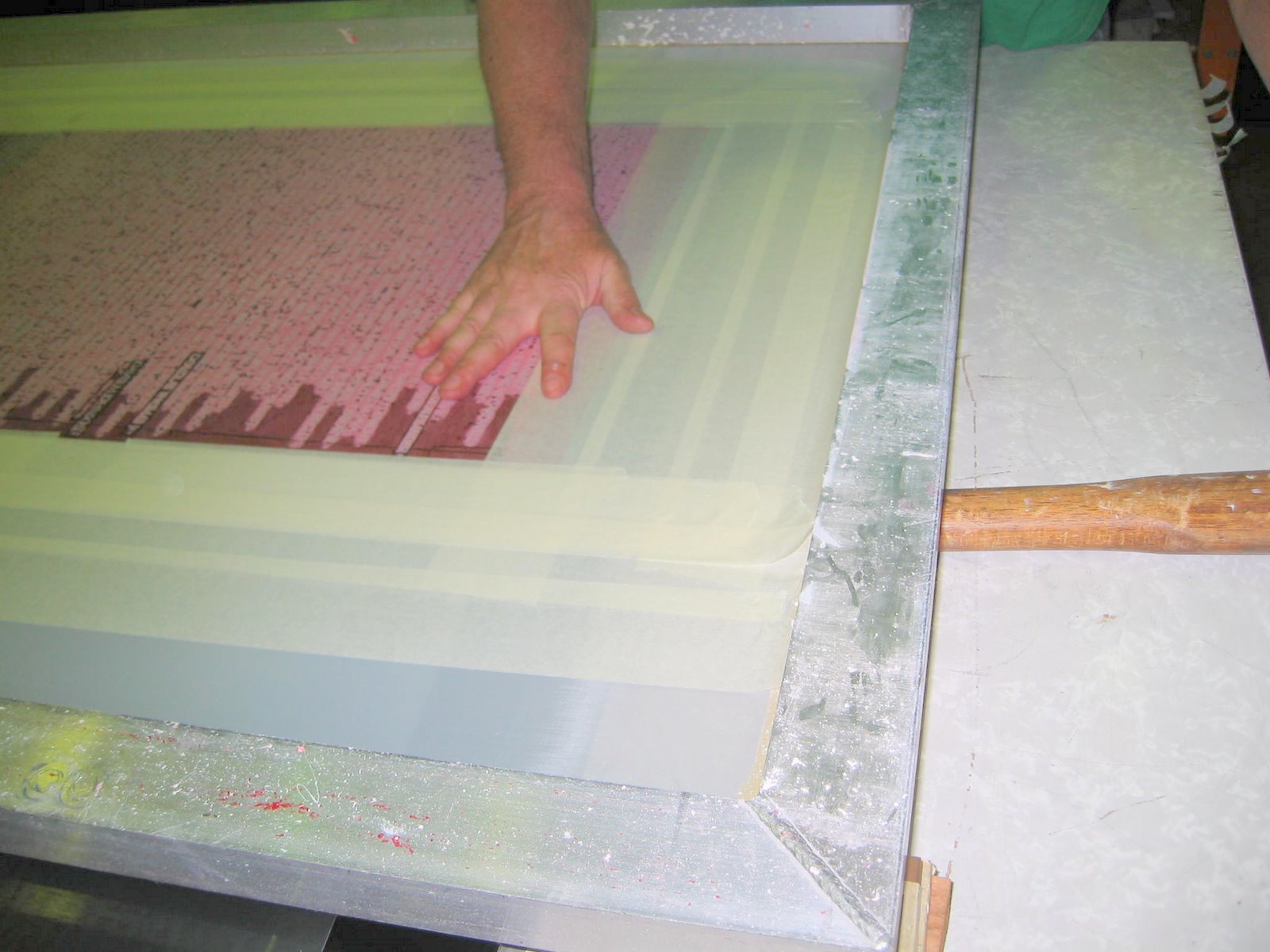
That done, the silkscreen is swung back up. They secure the panel in place on the table, and remove both transparency and paper, leaving the bare panel.
Enter John the Inkman. Ready to print, he puts the ink down for the moment and lowers the silkscreen back over the panel, checking the surface for irregularities (such as a warp) that could produce an irregularity in the print (faintness, blotchiness) if not corrected. He spots a warp, and instructs Joy to apply CPR-like pressure to the panel to get it to lay flat.
John then picks up the ink and pours a thick strip of the goopy ink across one end of the silkscreen.
Enter John the Inkman. Ready to print, he puts the ink down for the moment and lowers the silkscreen back over the panel, checking the surface for irregularities (such as a warp) that could produce an irregularity in the print (faintness, blotchiness) if not corrected. He spots a warp, and instructs Joy to apply CPR-like pressure to the panel to get it to lay flat.
John then picks up the ink and pours a thick strip of the goopy ink across one end of the silkscreen.

Again putting the inkpot aside, he picks up a two or so feet long, flat stick whose one end he offers Aaron and the other he keeps for himself. He and Aaron then lay the stick flat against the silkscreen just above the ink and, spacing their hands evenly across the stick, and with what seems like quite a bit of downward pressure, they slowly drag the stick the length of the panel, squeegee-like, in so doing forcing the ink through the free spaces of the silkscreen and onto the panel.

By the the end of the inking they are a little winded, but when the silkscreen is lifted up for a peek, voila!, a printed panel.

I don't know if the ink is expensive, if John is frugal, or if, like me, he is simply conscious of waste (maybe it's all three), but after each panel has been printed, all hands grab the frame and hold tight as he squeegees the stick back and recaptures every last bit of excess ink from the printing and returns it to the cup.

When the excess ink from this panel is back in the pail, they stand the silkscreen up on its side and lean in to inspect the panel more closely. Because the transparencies are old from which the silkscreens are made, and some damaged, whatever imperfections exist on a given transparency will appear on the printed panel. Therefore, there might always be a bit of touch up – dots that are gibbous or crescent but which should be full – which call for a fine paintbrush and a steady hand. On this day Jeff, Lisa's son, takes up this responsibility, and indeed the crew points out a number of spots for Jeff to touch-up.

As each panel bears two columns of names, a blank panel such as the one they have just printed would need to go through the whole process again to print the second column,
 but before the second column of names can be added the first column's ink has to cure and harden. Bake, actually. And so following the just completed printing and touching-up, Aaron carries the heavy, steel-framed panel over to the makeshift walk-in oven John had concocted that has been heated up to between 250 and 300 degree, in which the panel will bake until “done,” about forty-five minutes to an hour.


The last step of the process (for now) sees the framed silkscreen unclamped from the table hinge and carried over to a shower stall shrouded around with reddish shower curtains. There, donning a mask and a squirt bottle, Jeff sprays the screen thoroughly with bleach, the red from the silkscreen dissolving and washing away as he does.

Once cleaned and dried, that screen will be able to be shot with the image of another panel. Tomorrow's demonstration.
Several other panels are printed that day, probably three or four in all. Because the work is so exacting, it is also quite slow. This isn't any assembly line. It is, if not art, than at least artistic.
Several other panels are printed that day, probably three or four in all. Because the work is so exacting, it is also quite slow. This isn't any assembly line. It is, if not art, than at least artistic.
***
Throughout that process, which took much longer to complete than for you to read about, I was busy taking pictures, asking questions, generally getting in the way. And so I can't say how many White Piners actually took up John's invitation. Several people came in and out, though how many of them came to see the printing, and how many just dropped by to say hi, I could not tell. I did notice one guy – Jim – who dropped by and hung around for a while. Jim, a master carpenter (he mills his own wood), sat quietly in a chair by the table, drinking a beer and watching from afar.

That was all John wanted to hear. “That's my point. Not enough people know what we do out here. If they'd only come out and see, I think they'd get a better appreciation of The Wall, and what it takes to keep this thing going.” He took a sip of his Jack-splash-coke and then stared into the glass. “We've seen what happens when The Wall isn't kept up,” he said, leaning back, looking up. “A few years ago we retired the B wall and donated it to Pittsburgh State University, who built up this really nice memorial to house it permanently. I mean, they spent some money on the design and construction of the site, and we were kind of blown away. I mean, it's really nice. Has all these walkways and such. They must have spent a tone of money on it. But then they put up The Wall and just ignored it. Just left it to the elements. Well, it didn't take long for the Kansas weather to kick the crap out of it. Now, the panels are all kind of gray, and the names, you can barely see them let alone read them.

So now, they're trying to raise all this money to restore them, somehow. I think they're going to try to remake them in granite or something, something I guess they can make and then ignore.”

John, by nature, is slow to criticize, but his expression this moment does little to hide the dissatisfaction he feels toward the way The Wall has been treated out in Kansas. He says no more about it, but clearly he has more to say.
Jim leaves after a while, and other townsfolk come by, sometimes to stay for a beer, sometimes just to check in. Soon, George Thorogood's “Gear Jammer” (my pick) blares from Shanghai Kelly's jukebox, chips and salsa sail onto the table and fly off again almost immediately, and the workshop is on its way to becoming a playroom.
Drinking my beer, listening, watching, like a slow developing picture it's becoming clear to me what this shop means to White Pine, and what John wants it to mean to White Pine. By his design, the shop is as much social space for White Pine as it is workspace for The Moving Wall, and the relationship between the two, between social space and work space offers a kind of symbiosis: each breathes life into the other. Seats around the table are open to any who want to occupy them. The jukebox will play to any who want to push its buttons. The refrigerator opens to any who wants to pop a beer or chill a six. But so too, The Wall employs, in fact, proudly employs, about ten White Piners, making it one of the towns largest employers. And while I know that John isn't just going to hand out cash, I do get the sense that if someone is legitimately looking for work John will, if able, find a way to put them to work, even if for only a few hours a week. That someone who works on The Wall also sips beer at the table is natural; that someone who sips at the table might also work on The Wall is also natural. Chicken or egg.
Maybe I'm romanticizing, becoming melodramatic, but within just one day I got the sense that the shop was to White Pine what levies are to a slowly rising river. That throughout White Pine the tides of misfortune are mounting – lost jobs, lost property values, lost people, an overall lost sense of fortitude, of promise, of pride. Inside its door and walls, the shop holds back those tides. It doesn't erase them, but it doesn't admit them, either. Instead, the shop is kind of a refuge. In it, White Piners, gather in small numbers, and talk and laugh and play music and drink beer and dribble salsa down their sweatshirts, and for the time they spend in that warm chamber, perhaps themselves getting slightly baked, they are not cured of what ails them but their symptoms are chased away for a while.
In a sense, I suspect that what The Moving Wall is to the thousand-plus communities it's visited over the past quarter century, the shop of The Moving Wall is, or is becoming, to the community of White Pine. I will come back to this idea.


Saturday, April 3, 2010
The Shop (Part 1)

Joy answered.
“Hey Joy. I'm here.”
“Hey. Do you want to come to the shop?”
I hadn't actually anticipated going there so soon, but, why not? “Sure. I'd like that.”
“Okay. So you need directions, ā? Wait...”
I waited.
“John says he'll come and get you.”
“Great. I'll be waiting outside.”
A few minutes later I was standing in the Konteka's potholed parking lot when a cream colored Chevy pick-up, a relic, turned into the lot and gently rolled up to me. I hopped in the cab and John and I exchanged great-to-see-yous! He looked the same as when I saw him outside Boston this past summer, perhaps a dash more salt to his beard, perhaps another inch or so to his braided ponytail. But still the easy manner, the quick smile and laugh, even after a UP winter.
Between how ya doins I scanned the truck and was impressed by its near mint condition, especially for a truck its age, whatever its age was.
“This is some truck,” I said, “What year?”
“'87.”
“Damn. It's in great shape.”
“Yeah, it wouldn't normally be out this time of year. They dump so much damn salt on the roads that it just eats through metal. But we've had this warm weather, and it's melted all the snow. So I decided to take it out.”
“Sweet.”
“Yeah, back in the day I towed the Wall around with it.”
“You've really kept it up.”
“Yeah. I'm kinda proud of it.”
I nodded. Soon I would come to know that John was proud in many ways – not boastful, but proud.
* * *
Minutes later we rolled onto the property dominated under White Pine Electric, the old and soon to be decommissioned coal burning power plant.  The plant lords over a complex of mostly abandoned cinder block and metal-siding buildings, some of its own, others independent of it. I guess you'd call the site an industrial park, but at this point it's more the ghost of an industrial park.
 John pulled the Chevy up to a huge, blue, almost windowless building, with the trademark logo of The Moving Wall/Vietnam Combat Veterans emblazoned across a garage door. A handful of trucks were parked outside.

you bump up against a recently acquired pool table, covered, not yet in service, but soon to be. Pan left: just beyond the old truck, much much older than the '87,

I approached the racks and John followed. “Jesus,” I said, closing in on them, “I knew you had some stuff, but I had no idea you had that much stuff.”
“Yeah, It's quite a bit. The sponsors at each stop collect the stuff and send it to me, but I can't really do much with it right now. So, I just hang onto it all. Someday, I hope to find a proper home for it all, someplace that will display it properly, like it deserves.”

that all sorts of academics would be interested – anthropologist, psychologists, historians, to mention just a few – and of course, people like me, rhetoricians.)
“I can see already I’m going to have to come back,” I said, looking over to John. Then I spotted something, and he followed my eyes. To the left of the racks, lining a wall, were about a billion beer cans, neatly bagged, which if ever redeemed at a dime a piece, will catapult John and Joy into
a higher tax bracket.
“We really do need to cash those in,” he said, “it’s a small fortune, there. And they’re getting in the way. It’s not as bad as it looks.”
“Sure it isn’t,” I said.
He walked me away from the rack and the aluminum mine and showed me the office, whose walls were chock full of plaques and declarations and photos and clippings and on and on.


“C’mon, let me show you to the crew.”
On the way into the inner room we passed a woman, slight, in a red sweatshirt and red baseball cap, working intently, touching up a silkscreen.
“This is Joyce,” John said.
Joyce looked up to me briefly to say hi, and then returned to her work.
John then lead me through an opening into an even larger room. In it, a number of people were seated around a table, imbibing.

“We’ve been waiting for you,” said another, indicating the method by which they’d been occupying their time. “It’s all your fault.”
“Okay,” I said, holding up my arms in surrender. “Guilty as charged! I thought I’d be here much sooner.”
Joy, a woman of seeming endless energy, came bounding up to me. “You made it, ā?” she said with a hug and a smile.
Joy was a true-blue yooper, and she sounded to me more Canadian than American.
“I miscalculated,” I announced. “Thought Marquette was much closer than it is."
“You must need a beer then, ā?” Joy deduced.
“Why yeah, sure, I’d love one.”
“Or a drink. You want a drink? We’ve got other stuff to drink. A lot of stuff left over from our wedding.” (John and Joy had gotten married the year before, in the shop. Big party.)
What the hell, I thought. “Got any scotch?”
Joy disappeared and quickly reappeared with about half remaining of a 1.75 bottle of Dewar’s.
“How about this, ā?” She showed me the label.
“That’ll do just fine. Maybe too fine.”
She darted away to pour me a find a glass and ice, and the rest of us swapped introductions. There was Lisa and Aaron (they’re married), two Rons, Jeff (Lisa’s son), and Linnie.
“You’re the author,” one of the Rons said, and, not clear on the technicalities and wanting not to misrepresent myself, I corrected him.
“Not an author. But I am a writer.”
“What’s the difference?” he asked.
“I think author refers to some one who’s published something. I haven’t published anything – yet – so for now I’m just a writer.”
Still, author or writer, whatever I was changed the chemistry of the room.
I don’t know how many self-confessed authors/writers have passed through White Pine, but not so many that I wasn’t looked upon with curiosity, perhaps even a little suspicion. Clearly alien.
Lisa asked me a question, which I don't remember. I only remember her response to my answer I answer: a polite but vacant expression. I got the sense from her expression that I might have been speaking Chinese. It wasn’t Chinese, but coming from New York, and speaking fast, it might as well have been. I’d have slow down my speech a bit, not be in such a hurry.
Joy returned with my drink, poured just how I like it, right up to the brim.
“Thanks,” I said, looking around. This room was twice the size of the first room, and equally as interesting. Apart from the actual silk-screening equipment, there were photos of soldiers and a huge thank you banner hanging on the wall that separated this room from the garage.

There were yet more framed photos of the Wall from around the country crowding the room’s vertical surfaces.

“That?” he said laughing, taking a seat at the table, “That’s Shanghai Kelly. Take a look.”
I stepped inside the small, windowless, cinder block room out of which the music was bopping. John named it Shanghai Kelly, though one might mistake it for Shangri La, especially in White Pine, Michigan, 2 1/2 hours from Marquette.


And then there was the juke box,

It rocked.
I emerged from Shanghai Kelly’s kind of ga-ga, and asked John, “This is the best bar I’ve ever been in. Why would you ever leave?”
He smiled, but didn’t offer a reason. My guess is he couldn’t.
* * *
We spent the next several hours chatting, listening to great music, and yes, drinking. I was able to dial back my New Yorkese from 45 rpm to 33, and was much better understood as a result. I learned a little bit about everyone there; that Aaron and Lisa were road stewards to the A wall, and have been for several years; that one of the Rons was Lisa's half brother; that Linnie cooked at the Konteka and would be making my breakfast come the morrow (if I saw it); that Aaron had served in the Gulf War; that these were all genuinely nice, down to earth people. I also learned a thing about John that night.
"You know," he said, taking a sip from his Jack-splash-coke, "It really pisses me off that no one knows what we do here." [Note: it's inconceivable that anything really pisses off John -- he's just too much on an even keel to get knocked into pissed off. I believe, though, that he can become peeved.]
He continued: "No one around here has any idea what we do. They think we take the Wall on the road, bring it back here, pack it away, and spend the winter drinking in the American Legion. They don't know the work we put into the Wall, into maintaining it."
He took another sip. "That's why I've been trying to get people to come out here, to see what we do, because if they did, they wouldn't believe it. My goal is to have everyone in town come out here to see what we do, to see the whole process. Then they'll know."
John offered the town of White Pine a standing invitation to come out to the shop and see what goes on. By word of mouth he lets it be known when he and his crew will be doing what process, though the door to the shop is always open for anyone to drop by and just grab a beer from the fridge, or play Shanghai Kelly's juke box (it's free). John hopes that the social atmosphere he's created in the shop will spill over into a greater interest in, and understanding of, the winter Wall. Tomorrow, for instance, he has scheduled printing panels at 1:00. A few people have said they'll drop by, and others will likely drop by unannounced. By the end of the night, I got the strong sense that this shop was much more than the winter home of The Moving Wall. I wasn't sure what that more was just yet, but I trusted that the next few days would make that clear to me.
Monday, March 29, 2010
The New Frontier
As I mentioned in an earlier post, I went to White Pine in search of The Wall. I didn't anticipate that White Pine itself would be of interest to me, but it is.
Why?
I have long known what The Moving Wall has meant and means to people across the country; but once in White Pine, I began to realize that The Moving Wall holds increasing meaning for its immediate neighbors, and that, too, is a story worth telling about this structure, so simple in design, so complex in effect.
Beginning with this post, then, I will toggle between writing about The Wall in its winter home and all that envelopes it in the shop, and then how it exists outside, within the larger community of White Pine. In other words, some posts will live within the walls of the shop; others will stretch their legs out into the streets of White Pine.
I should also say that if the connections between The Wall and White Pine aren't yet apparent to you, join the club: they are not yet apparent to me, either.
But I also trust, and I hope you will, too, that in the working out of the observations, impressions, and details, the connections will become more apparent to us both.
And, for whatever it's worth, let me be frank: I am a writer, and part of my personal interest in writing this blog is to bump up against my limitations in the execution of it, and then to overcome them if I can. If you have suggestions how I might do that, feel free to include them as a "comment." I won't say that I will revise to suit every comment, but I guarantee that I will at least read every comment.
So, let me begin today by telling you a little about The Konteka Inn, where I stayed during my time in White Pine.
The drive from the airport in Marquette, MI, to The Konteka Inn in White Pine took about 2 ½ hours, not the 1 ½ hours I (mis)calculated.

That meant an hour more of pine trees and cut logs and long stretches of road with only me on it. It also meant another hour of trying to dodge Christian radio in search of secular stations: no easy task in the UP.
Arriving successfully unconverted, I pulled into White Pine and The Konteka Inn (officially The Konteka Black Bear Resort) and its big barren parking lot.

A smattering of cars scattered around the mud and potholes. The Konteka's website boasted the ability to accommodate trucks and and their snowmobile trailers,
 but none were to be found, as was not the case only a week or so earlier, when the yooper snows were deep. But a spate of warm weather had all but laid bare the forest floor, and the snowmobilers who might have come from far and wide stayed far and wide.
Bad for Konteka. Fine by me.
I climbed out of the Dodge Caravan I had rented and took a quick 360. The Inn was a bit more rustic than pictured on its website, and smaller.
As I walked into the combination front desk/restaurant/bar/gift shop/bowling alley, a couple guys were having a quiet beer, naturally ignoring the chattering TV head in the bar. I saw no one else. I rang the bell on the registration counter, but no one hopped-to.
Assuming that eventually someone would come my way, I passed the time looking at the den of slightly blurred framed photos of black bears which populated the walls. I am not a bearologist but even I could tell that these photos were not of the same animal. The bear were clearly of different sizes and weights.
The biggest, standing tall and looking straight at me, curiously, not ferociously, wearing a "Well, gee, who are you?" or "Well, gee, what are you dong here?" expression, had a daffodil yellow dot the size of a quarter in each ear, and I thought the adornment quite complimentary.
There were also photos of bears dining at what looked to be the edge of woods that I could see through the Konteka's dining room windows.

These weren't just any old bears, then, they were local bears. The photos were family portraits. The Konteka's kids.
After a moment or two a young woman approached in black pants and shirt (bear chic?) who seemed a bit frantic. She apologized; she was all "alone." I gathered that she wore a number of hats for the Inn, though given the absence of any customers or guests, I wondered what they might be.
She stepped behind the check-in desk which reminded me of an empty jeweler's case. I told her that I had a reservation, that my name was Blitefield, and that I had requested the quietest room possible.
She returned a quizzical look but even as I said it, I understood that look, and agreed, feeling a bit foolish about that last part, given what 'd seen with my own eyes. This wasn't some spring break get-to with Girls Gone Wild going wild. It was an empty hotel. Still, she humored me and said “Room 115. Our quietest,” she said, handing me my key – not a card, not some other kind of modern entry gimmick – but a regular key, and told me that, as things were quiet, the owner might have locked some of the accesses to the parking lot, and that it would be best if I grabbed my things and went to my room via the bowling alley, which I did.
 I don't know why they called my room “115”, unless there had once upon a time been more floors to The Konteka, or that some distant plans were in the making for adding some. As the rooms were on one floor, why not just “15”?
Anyway, I walked down the single dark hall toward my room passing rooms 101, 102, 103, etc., many of which had the European sign for no-smoking affixed to their door. Despite the signs, or perhaps in defiance of them, the hall smelled of deep-soaked cigarettes nonetheless. (Michigan hasn't yet caught up with the rest of the country regarding cigarette smoking, and so smoking is pervasive.)
Room 115 was at the end of the hall on the left, just before the coin-operated washing machine and dryer, which were just before the “spa” (jacuzzi).
Room 115's curtains opened onto the woods behind the Konteka (as did all the odd numbered rooms; the even numbered rooms look on to the parking lot and the Mineral River Plaza.) Indeed, the room was quiet, as I had requested, though there was always the possibility, and hence, my fear, that some night owl or yooper yahoo might decide to do laundry at one or two in the morning, no doubt drying a coat with a heavy metal zipper or hard buttons.
Rm 115 was non-smoking but had obviously absorbed undertones of cigarettes. It was also, by the Gucci-goo standards of the east coast, worn, a bit shabby. But it was neat, mostly. It's furnishings were serviceable. A boxy, sharp edged (circa '?0s?) wood laminate dresser and night table, probably standard of a mountain lodge, stood at the ready for the contents of my meager suitcase.
 The TV was ten or fifteen years old but not so old as to be pre-clicker, and giving it a test run I found that it worked well enough for the amount of viewing I was planning to do (zero).The mattresses of the twin queen beds had colorful polyester covers, but mattresses were tired and soft.

Rm 115, in other words, was a basic room, comfortable but not cozy; the very muted and zest-free room which comes with a $54 nightly rate. One thing stuck out, though.
In the bathroom, on the wall above the toilet, a flourish of creativity, of design, of personal touch, maybe even wit: a towel rack had been stocked with descending, drooping boughs of towels of increasing sizes and length, beginning with a stack of face cloths at the top, and concluding with bath towels at the bottom. A sort of white pine of cotton.

So, initial impressions of The Konteka: quiet, simple, smokey, and essential. A place proud of its bears, proud of its bowling alley, bar, spa, and gas pump; a place where some creative housekeeper is proud of her work.
My next post will resume back in Rm 115, but only so long as it takes me to make the I'm here! phone call to John and Joy, and make my way over to The Wall.
Why?
I have long known what The Moving Wall has meant and means to people across the country; but once in White Pine, I began to realize that The Moving Wall holds increasing meaning for its immediate neighbors, and that, too, is a story worth telling about this structure, so simple in design, so complex in effect.
Beginning with this post, then, I will toggle between writing about The Wall in its winter home and all that envelopes it in the shop, and then how it exists outside, within the larger community of White Pine. In other words, some posts will live within the walls of the shop; others will stretch their legs out into the streets of White Pine.
I should also say that if the connections between The Wall and White Pine aren't yet apparent to you, join the club: they are not yet apparent to me, either.
But I also trust, and I hope you will, too, that in the working out of the observations, impressions, and details, the connections will become more apparent to us both.
And, for whatever it's worth, let me be frank: I am a writer, and part of my personal interest in writing this blog is to bump up against my limitations in the execution of it, and then to overcome them if I can. If you have suggestions how I might do that, feel free to include them as a "comment." I won't say that I will revise to suit every comment, but I guarantee that I will at least read every comment.
So, let me begin today by telling you a little about The Konteka Inn, where I stayed during my time in White Pine.
***
The drive from the airport in Marquette, MI, to The Konteka Inn in White Pine took about 2 ½ hours, not the 1 ½ hours I (mis)calculated.

That meant an hour more of pine trees and cut logs and long stretches of road with only me on it. It also meant another hour of trying to dodge Christian radio in search of secular stations: no easy task in the UP.
Arriving successfully unconverted, I pulled into White Pine and The Konteka Inn (officially The Konteka Black Bear Resort) and its big barren parking lot.

A smattering of cars scattered around the mud and potholes. The Konteka's website boasted the ability to accommodate trucks and and their snowmobile trailers,
 but none were to be found, as was not the case only a week or so earlier, when the yooper snows were deep. But a spate of warm weather had all but laid bare the forest floor, and the snowmobilers who might have come from far and wide stayed far and wide.
 Bad for Konteka. Fine by me.
I climbed out of the Dodge Caravan I had rented and took a quick 360. The Inn was a bit more rustic than pictured on its website, and smaller.
As I walked into the combination front desk/restaurant/bar/gift shop/bowling alley, a couple guys were having a quiet beer, naturally ignoring the chattering TV head in the bar. I saw no one else. I rang the bell on the registration counter, but no one hopped-to.
Assuming that eventually someone would come my way, I passed the time looking at the den of slightly blurred framed photos of black bears which populated the walls. I am not a bearologist but even I could tell that these photos were not of the same animal. The bear were clearly of different sizes and weights.
The biggest, standing tall and looking straight at me, curiously, not ferociously, wearing a "Well, gee, who are you?" or "Well, gee, what are you dong here?" expression, had a daffodil yellow dot the size of a quarter in each ear, and I thought the adornment quite complimentary.
There were also photos of bears dining at what looked to be the edge of woods that I could see through the Konteka's dining room windows.

These weren't just any old bears, then, they were local bears. The photos were family portraits. The Konteka's kids.
After a moment or two a young woman approached in black pants and shirt (bear chic?) who seemed a bit frantic. She apologized; she was all "alone." I gathered that she wore a number of hats for the Inn, though given the absence of any customers or guests, I wondered what they might be.
She stepped behind the check-in desk which reminded me of an empty jeweler's case. I told her that I had a reservation, that my name was Blitefield, and that I had requested the quietest room possible.
She returned a quizzical look but even as I said it, I understood that look, and agreed, feeling a bit foolish about that last part, given what 'd seen with my own eyes. This wasn't some spring break get-to with Girls Gone Wild going wild. It was an empty hotel. Still, she humored me and said “Room 115. Our quietest,” she said, handing me my key – not a card, not some other kind of modern entry gimmick – but a regular key, and told me that, as things were quiet, the owner might have locked some of the accesses to the parking lot, and that it would be best if I grabbed my things and went to my room via the bowling alley, which I did.
 I don't know why they called my room “115”, unless there had once upon a time been more floors to The Konteka, or that some distant plans were in the making for adding some. As the rooms were on one floor, why not just “15”?
 Anyway, I walked down the single dark hall toward my room passing rooms 101, 102, 103, etc., many of which had the European sign for no-smoking affixed to their door. Despite the signs, or perhaps in defiance of them, the hall smelled of deep-soaked cigarettes nonetheless. (Michigan hasn't yet caught up with the rest of the country regarding cigarette smoking, and so smoking is pervasive.)
Room 115 was at the end of the hall on the left, just before the coin-operated washing machine and dryer, which were just before the “spa” (jacuzzi).
Room 115's curtains opened onto the woods behind the Konteka (as did all the odd numbered rooms; the even numbered rooms look on to the parking lot and the Mineral River Plaza.) Indeed, the room was quiet, as I had requested, though there was always the possibility, and hence, my fear, that some night owl or yooper yahoo might decide to do laundry at one or two in the morning, no doubt drying a coat with a heavy metal zipper or hard buttons.
Rm 115 was non-smoking but had obviously absorbed undertones of cigarettes. It was also, by the Gucci-goo standards of the east coast, worn, a bit shabby. But it was neat, mostly. It's furnishings were serviceable. A boxy, sharp edged (circa '?0s?) wood laminate dresser and night table, probably standard of a mountain lodge, stood at the ready for the contents of my meager suitcase.
 The TV was ten or fifteen years old but not so old as to be pre-clicker, and giving it a test run I found that it worked well enough for the amount of viewing I was planning to do (zero).The mattresses of the twin queen beds had colorful polyester covers, but mattresses were tired and soft.
Rm 115, in other words, was a basic room, comfortable but not cozy; the very muted and zest-free room which comes with a $54 nightly rate. One thing stuck out, though.
In the bathroom, on the wall above the toilet, a flourish of creativity, of design, of personal touch, maybe even wit: a towel rack had been stocked with descending, drooping boughs of towels of increasing sizes and length, beginning with a stack of face cloths at the top, and concluding with bath towels at the bottom. A sort of white pine of cotton.

So, initial impressions of The Konteka: quiet, simple, smokey, and essential. A place proud of its bears, proud of its bowling alley, bar, spa, and gas pump; a place where some creative housekeeper is proud of her work.
My next post will resume back in Rm 115, but only so long as it takes me to make the I'm here! phone call to John and Joy, and make my way over to The Wall.
Thursday, March 25, 2010
The Moving Wall: Hardware, worn hard.
John returned to California jazzed. Despite the controversy surrounding the Vietnam Veterans Memorial's design, he was less concerned about the memorial as a proper tribute than he was about the power that that memorial, proper or not, exercised on Vietnam vets. Two things he learned:
the power of simply seeing a name;

the power of being in community with other vets.

One could precipitate
a sense of plunging;

the other,
of raising up.

For John, The memorial wasn't important for what it was but for what it did.
And that is The Wall as it exists today. There is still an “A” schedule, now shepherded by Aaron and Lisa,


and a “C” schedule, toted by John and Joy, though one can't help notice two things about the two schedules for this 2010 season. The first is that the “A” schedule as many more stops on its calendar than does the “C”, twenty-two to twelve. Also, the “C” schedule is more geographically circumscribed than is the “A” schedule, with most of its stops in the Midwest (Michigan, Iowa, Missouri, etc.). The “A” Wall will span from California to Georgia. When I asked John why that is, whether requests for The Wall had dropped off, he said, “No. I'm just getting tired. Twenty-six years on the road, and I'm looking to stay a little closer to home.” Fair enough.
the power of simply seeing a name;

the power of being in community with other vets.

One could precipitate
a sense of plunging;

the other,
of raising up.

For John, The memorial wasn't important for what it was but for what it did.
Powerful as the memorial was, it wasn't powerful enough. It couldn't give legs to the amputee; couldn't enable the blind to see; couldn't put dough in the pockets of the indigent; couldn't put vacation time on the calendar; couldn't provide travel for widowed wives and fatherless kids, sonless parents and brotherless siblings; couldn't shrink the distance between here and there; it couldn't do a lot of things for vets and their families desirous of going to The Wall in DC but who were physically, financially, or emotionally unable to do so. John felt the huge gap between what The Wall could do, but also what it couldn't do, and he felt the need to remedy that, to close that gap for all vets and their families. To provide them the experience that he and his brothers had in DC.
When he returned to San Jose he and a couple of friends decided to replicate the experience. They made a makeshift memorial of names that they planned on exhibiting in a few towns in the San Jose area. Their efforts were more symbolic than sturdy; I believe he said that those first panels were made out of cardboard.
They took their memorial out into the area, and what they found there was overwhelming, a response far greater than anything they anticipated. The generous outpouring of gratitude and support from those local communities confirmed in John the suspicion that the power of the Wall wasn't anchored in the granite of DC but rather was anchored in the ghosts of memory evoked by it. John realized the Wall was a medium; properly duplicated, those ghosts could be exorcised anywhere. It was then that John got the idea to go farther, much farther than San Jose.
His idea: to replicate The Wall, in miniature, just as it appeared in DC, and take it on the road. With the help of friends he scrambled to find funding, but did. A couple grand. Then, with help from the the Vietnam Veterans Memorial fund, and, with the permission of the National Park Service, in 1983 he returned to Washington and photographed, with great precision, each of The Wall's 140 panels.
When he returned to San Jose he worked with Norris Shears, an area silk-screen artist and former Vietnam vet himself, and Gerry Haver, to have the photographs converted to silkscreen transparencies. With the generosity of local businesses, he also had made black plexiglass panels, six feet tall where the two wings of The Wall met (1E and 1W),
gradually winnowing down to a few feet at the wings' extremities (70E and 70W). He and his crew then carefully silk-screened in white letters the names on each panel, exactly as they appeared in DC. The Moving Wall had been created.
 panels.
 When he returned to San Jose he worked with Norris Shears, an area silk-screen artist and former Vietnam vet himself, and Gerry Haver, to have the photographs converted to silkscreen transparencies. With the generosity of local businesses, he also had made black plexiglass panels, six feet tall where the two wings of The Wall met (1E and 1W),

gradually winnowing down to a few feet at the wings' extremities (70E and 70W). He and his crew then carefully silk-screened in white letters the names on each panel, exactly as they appeared in DC. The Moving Wall had been created.
That first year, 1984, John set up The (Moving) Wall in four locations; the following year, it hit eighteen stops. In 1987, a second “B” Wall was added to handle the overwhelming demand. A “C” was added in 1989. In 2000, its peak year, John and his colleagues trucked the Wall(s) to sixty-six municipalities, from Angel Fire, NM, to Whittier, CA; from Alaska to Texas; and from Maine to Hawaii. Coordinating the three Walls proved to be too much, though, and in 2001 John retired the “B” Wall. In 2002, he donated the “B” Wall to Pittsburgh State University (KS) who turned it into a permanent memorial. Aerial View, The Pittsburgh State Veterans Memorial
Since it first hit the road, The Wall has been hosted by over a thousand towns across the United States, and even in Saipan and Guam. (If you'd like to see a full list of all the places The Wall has been, go to http://www.themovingwall.org/docs/history.htm )Aerial View, The Pittsburgh State Veterans Memorial The plexiglass construction of the early Wall soon proved insufficient to the task. Sun damage, wind damage, scratches, warping, made the Wall impossible to maintain, and by 1986 John had moved to designing a more durable, roadworthy structure. He replaced the plexiglass panels with metal panels, each painted and baked with a black, tough, high-gloss finish. He silk-screened these metal panels just as he had the plexiglass, and The Wall was reincarnated, identical looks, but more muscle.


And that is The Wall as it exists today. There is still an “A” schedule, now shepherded by Aaron and Lisa,


and a “C” schedule, toted by John and Joy, though one can't help notice two things about the two schedules for this 2010 season. The first is that the “A” schedule as many more stops on its calendar than does the “C”, twenty-two to twelve. Also, the “C” schedule is more geographically circumscribed than is the “A” schedule, with most of its stops in the Midwest (Michigan, Iowa, Missouri, etc.). The “A” Wall will span from California to Georgia. When I asked John why that is, whether requests for The Wall had dropped off, he said, “No. I'm just getting tired. Twenty-six years on the road, and I'm looking to stay a little closer to home.” Fair enough.
Regardless of the route each Wall sets out on, all roads, eventually, lead back to White Pine. Once there to bed down for the winter, each panel will be inspected, touched up when possible,

and completely re-silk-screened when not.

So, when spring rolls around, John will settle for nothing less than perfection as the Walls head out onto the road, not because he is a perfectionist, but because perfection of the Wall is his way of honoring the names on it, and respecting those who'll come before it.


and completely re-silk-screened when not.

So, when spring rolls around, John will settle for nothing less than perfection as the Walls head out onto the road, not because he is a perfectionist, but because perfection of the Wall is his way of honoring the names on it, and respecting those who'll come before it.

Subscribe to:
Posts (Atom)